
How to Become a Freelance Blogger in 2024
I’m a BIG advocate of freelance blogging.
I’ve been a professional blogger — one that gets paid by companies and makes money on my own blog — for the last 6 years. Honestly, I can’t recommend it enough. It’s the perfect job for the writer at heart that’s looking to become a digital nomad.
Writing is a skill that’s in demand, and there’s plenty of room to grow. You don’t have to be an expert, you can learn everything you need to. Not to mention, the entry costs are low.
If you’ve been thinking about becoming a freelance blogger, now’s the time to start looking for blogging opportunities. Let’s talk about how to make that happen:
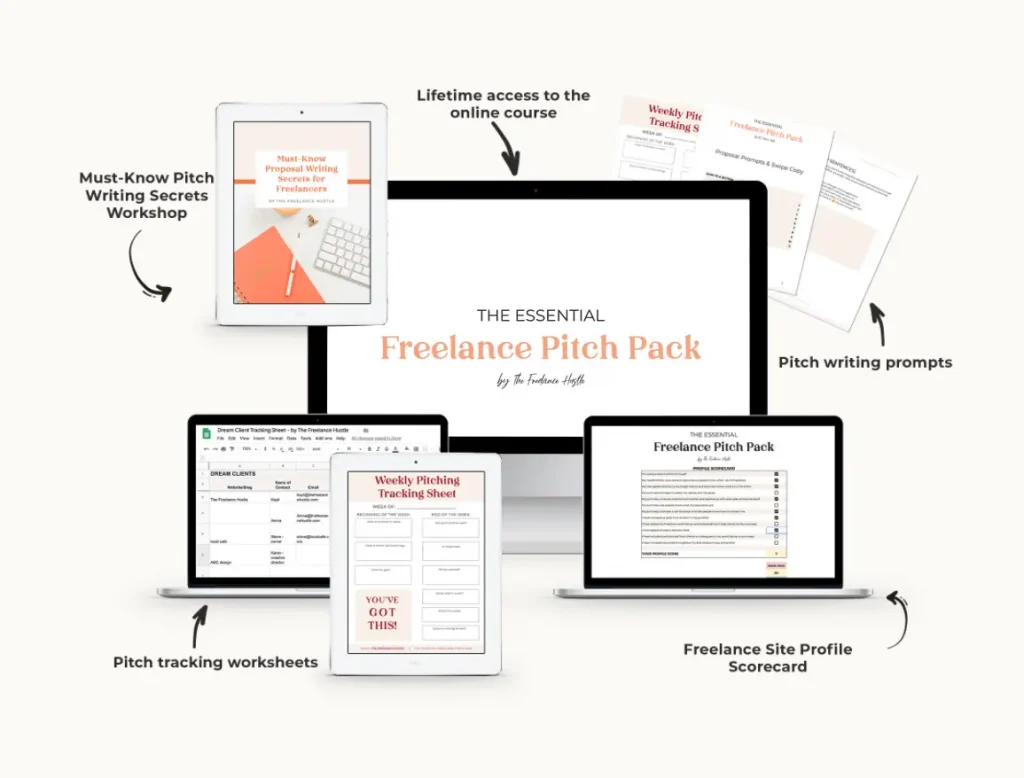
Trying to land more clients and projects?
You need the Essential Pitch Pack!
YES PLEASE »
What is freelance blogging?
Freelance blogging is exactly what it sounds like — it’s a freelance writer that focuses on blog post writing opportunities. While it might not sound like the most lucrative niche, I can confirm that there’s definitely money to be had.
It’s the perfect job for anyone who loves create content that’s long-form (typically 600+ words), and doesn’t mind hunting around for their own clients. Honestly, it’s my number one recommendation whenever anyone asks what the perfect job for a digital nomad is.
I love that ultimately writing is a skill you can learn. You don’t need a ton of experience to start cold pitching and finding blogging services. You can learn everything you need to make a living writing on the internet (like on this blog!) and start building the blogging business of your dream.
Why get paid to blog?
Blogging is a leading driver of content marketing strategies and a fast-growing trend in digital marketing. If you’re looking to make money online as a writer, freelancing as a blogger is worth a serious look.
Low start-up costs
The start-up costs are limited, you’ll essentially need a/n:
- Laptop
- Internet access
- Your own website to show off your skills
- Professional email account (GDrive is where it’s at)
- Accounting program (Honeybook is my favorite)
- SEO tool for research (I like Keysearch for beginners)
When you boil it down, the costs are hella low. If you postpone the SEO tool and professional website, you could do it for completely free. Just make sure you have plans to add those two things at the earliest opportunity so you can snag more freelance blogging jobs!
Honestly, the costs are low AF.
Ideal career
It’s not just the costs that are low though. The overall freelance blogging career provides some great benefits considering you can:
- Choose your own hours
- Pick the projects you want to work on, and turn down the ones that aren’t interesting
- Build your own business
- Be your own boss (hell, yeah!)
- Have considerable flexibility (AKA take a vacation when you want to)
- Work from anywhere (you can double as a travel writer too)
Blogging is serious business, and there’s plenty of room to use it to your economic advantage. According to Ahrefs:
- 60% of marketers say content marketing (which includes blog writing work) generates leads
- 74% of companies report that blogging increases the quality and quantity of leads
- 65% of B2B buyers say websites are a leading decision-making influencer
If you have a talent and passion for writing, particularly in the online world, freelance blogging might just be for you.
How to become a freelance blogger
You don’t have to be an expert writer to capture freelance blogging jobs. You don’t need a fancy degree or your name attached to big publications, you simply need to have the passion and drive to start and run your own business. And a love of working on blogs!
Before we get too far into the how let’s go over a few quick things you’ll want to keep in mind:
- While blogging for others will get you paid faster than blogging for yourself, you need to give yourself time to build up a good potential client list
- Maintain your own blog for visibility and extended income
- Offering more with your freelance writing business packages (like SEO or proofreading) can help give you more flexibility and bring up the price
- You NEED a contract, don’t forget to put one in place before you start working!
- If your clients are late with payment STOP WORKING
Here’s what you’ll want to do:
1. Choose a niche
Long-form content is the way to go in my books, primarily since that’s what I do. Compared to short blog posts, long-form content sees 77.2% more links. But it’s usually not enough to simply differentiate yourself due to writing long-form blog content. The best freelance writers specialize in a few niche areas.
There are a ton of lucrative freelance blogging niches, but the perfect one for you is going to be whichever one you already know or are excited to learn about. Yes, you can write about anything considering research is so easy these days, but it gets old fast.
Most freelance coaches and blogging experts recommend you choose a single niche and simply go with that. But I disagree, especially when you’re just starting.
If it’s your first kick at the freelance blogging can, you don’t know what you enjoy writing about nor do you know what you’re good at. Couple that with the fact that the freelance blogging jobs out there for those of us with limited experience don’t always include specialty niches. All-in-all, you honestly want to keep your options open.
I’m not saying write anything and everything (don’t, it’ll get old fast!). But you want to pick a few adjacent niches so you have some options. Perhaps you’re super passionate about fashion, you might also explore the beauty and home aesthetics niche. If you’re a personal finance expert, you might also want to give goal planning and career growth a try.
Pick things that go together, but give yourself enough options that you aren’t restricted right off the bat. You need to build that portfolio, and the best way to do that is to get blogging jobs!
2. Start a blog
If you want to be a freelance blogger, you need to run your own blog.
There are 600 million blogs out there, and 60% of consumers say that blogs are a contributing factor during the buying process—so, why not help your customers out?
Not only does running a blog give you a solid foundation to build your portfolio (which definitely beats using third-party sites like Contently), but it allows you to build a second stream of income.
Yes, blogs make money. And yes, you can use this to your advantage!
Starting a blog isn’t hard—you can start one from scratch or buy one already built. Either way, as long as you nurture it, you can reap the long-term benefits. If you aren’t planning on getting into niche blogging, you can simply add a blog to your business site and blog about whatever your focus field is.
3. Get to know SEO
Search engine optimization (SEO) is the bread and butter of freelance blogging. While there are plenty of other freelance writing niches that can get away without getting lost in SEO, blogging is not one of them.
SEO is imperative when it comes to getting content found, which is ultimately why companies hire bloggers. They want their content to be found, and it’s your job to help ensure that happens.
Not only is SEO important for your work product, if you’re good at it you can charge a little more. There is a lot of upfront work involved in comprehensive SEO, and you should be compensated for it.
In addition to actually penning the content, SEO writers often:
- Research and plan keywords
- Prepare detailed briefs
- Place keywords
- Create keyword-rich meta content
Learning the ins and outs of SEO will help both your clients and you. You can use it to boost your own blog, which can help you create stellar work samples and a little side cash for a diverse income.
In fact, there are a lot of tricks you can learn as a freelance writer that can help on your own blog and beyond. The good news is that learning SEO doesn’t have to be hard. The bad news is, there can be a lot of changes to keep up to date on.
4. Create stellar sample content
Like any other area of freelancing, you need writing samples to show potential clients. This is your time to shine as a freelance blogger. You can be the most fun, personable, and lovely individual to work with, but if your writing sucks, it’s going to be hard to get the job.
This doesn’t mean that you have to be the best, you don’t. But you need well-articulated, high quality content to help show off your stuff.
It doesn’t matter what you’re writing about, whether it’s a blog post or an article for a magazine, if the words don’t flow, your clients aren’t going to get that warm and fuzzy feeling. Without that engagement, chances are they aren’t going to buy from you.
For writing to be effective (and truly purchasable) the most important factor (boringly enough) is to make sure it’s clean.
When I say clean, I mean that there are no spelling or grammatical errors — adult content sites need writers too! You should go through and do a line-by-line edit, but here are some general tips to help you create quality content:
- Don’t get too fancy with your grammar, avoid semi-colons and colons because 99.9% of people (not an actual stat) use them incorrectly.
- Make sure your sentences are short and sweet. Not only will this help you with online readability, but it will also help you avoid run-on sentences.
- Be mindful of filler words, things are rarely VERY important… definitive and expressive words like “important” or “crucial” are usually enough to get the point across without the very/extremely/insert overly descriptive word. Cut the fluff, I promise the piece will better overall better!
- Plenty of people will disagree with this, but: it’s OK to bend the rules of grammar in certain cases when it comes to online writing. However, do it with intention, do it sparingly, and do it well.
- Be consistent. Itching to use the oxford comma? Totally cool, just make sure you stick with it. Don’t think post-production should be hyphenated (you’d be wrong but) just make sure you write it the same way throughout the entire piece. If it’s your blog you’re writing for, make sure it’s the same everywhere.
At the end of the day, make sure you’re clear and concise. It never hurts to run your work through a tool like ContentWise or even just use Grammarly before you hit publish.
5. Find clients
Most freelance bloggers tell me the biggest thing they struggle with is finding clients — specifically ones that pay well. They hesitate to approach potential clients, and instead wait for the clients to find them… which isn’t going to happen.
There are two big reasons why this happens in my mind: there’s a TON of imposter syndrome. Blogging isn’t a regular job, so I find that new bloggers are shy about sharing what they do and approaching new clients because they’re not sure the service they offer is really needed. The second reason is they don’t know how to evaluate and reach out to clients.
There are 3 ways I get clients:
- Apply for freelance blogging jobs — I don’t do this anymore, but it’s a great way to get started. Job boards like ProBlogger or Freelance Writing Gigs have fresh new jobs you can apply for posted regularly. I will say these freelance writing jobs tend to pay mediocre or just plain bad, but it’s a good place to get your blogging feet wet.
- Get referrals from current clients — when clients love your work, they like referring your services. This is especially the case if you ask them to do so.
- Cold pitch prospective clients — most of my highest paid clients have come from pitching. This happens because I purposefully reach out to companies that I love already and propose working for them. They tend to be receptive because I actively use, recommend, and love their services.
Before you head out to find clients, it’s important to remember that you’re also out there vetting clients. Just because someone wants to hire you doesn’t mean you have to accept. It’s your business, and nightmare clients are both a spirit and bank account killer.
Seriously, it’s a problem!
If at any point during the process you feel red flags creeping up, I highly recommend you stop wasting your time on that prospect. You have instincts for a reason, go with them
Making money as a freelance blogger
Freelance blogging is a great way to make a little extra cash, or fund your entire life. It all depends on what you’re looking to get out of the gig.
If you want to bring in an extra $500/month, that’s totally doable. If you want to make a full-time living writing, that’s also possible — just takes some hustle.
Here’s how you actually earn money as a freelance blogger:
Set your rates
There’s no set rate you have to charge as a freelance writer. Oddly enough, content writer rates tend to be a personal decision. Everything from your experience level and passion, to the client’s budget, will affect what you end up charging.
I can’t tell you what to charge, but I can tell you that you need to have a bottom line in mind and NOT go below that point. You must know how much you need to make to be able to pay your bills or do whatever it is that you need to with your freelance cash.
You also need to take into account taxes and any program fees or subscriptions you need to pay for to run your blogging business.
In my mind, a good starting rate for a freelancer is anywhere from $0.05 per word to $0.10. If you’re brand new, I wouldn’t expect to get more than $0.10 — not because your work isn’t worth it, but simply because you need to be able to prove yourself.
That said, I highly encourage you to charge a fixed price PER PROJECT not PER WORD. It will work out better for you and the client in the end (assuming you price yourself correctly) because everyone has a predictable budget that way. Definately do not charge an hourly rate.
Do the work
Obviously, you need to do the work. You can’t get paid without it.
With freelance blogging, the work is usually simple:
- Outline the post
- Research the content
- Write blog posts
- Proofread the piece
- Send it to the client
- Do any changes — I recommend making sure your contract has a maximum number of changes
Then you’re done.
The big downside with freelance writing — and the reason why I’m so big on having multiple income streams — is the fact that what you make is directly tied to how many pieces of content you can create for your blogging clients.
It might only take you a few hours to pump out a piece of content, but I can tell you that the MOST client pieces I’ve been able to do in a single day were 5. Those 5 took a long time to complete, and the only reason I was able to do it was that everything was part of the same project. That meant that I didn’t have to do a bunch of independent research, which made it more efficient.
It’s up to you how much you work, but always over-estimate the time you need because you don’t want to be left without enough.
Get paid
Finally, you want to get paid. Otherwise, you’re simply volunteering, and that sucks.
I advocate for getting at least 50% of the payment upfront, but go for the full 100% if you can. Leaving it all until after means that your client could walk away without paying you. I wish I could tell you that didn’t happen, but it does.
To get paid, you’ll need to send an invoice to your client and provide payment options. Using PayPal, Stripe or a direct bank transfer is usually the easiest. I use direct transfers via Wise and take credit cards with Stipe, which is also connected to my Wise account. That way I retain whatever currency I was paid in until I’m ready to convert it.
You want to make sure that you record all payments in a program like Freshbooks so you’re ready when tax time comes
Downsides to being a freelance blogger
While I love being a freelance blogger, there are absolutely downsides.
From irregular pay to chasing down clients, some things can be a real pain. However, if you’re up for the challenge, I really do think it’s worth it.
Just be prepared for the ups and downs that come with it. Here are a few more things you should know:
You constantly need to market yourself
Even if you have a “full” client load with a good roster, you’re truly never not looking for clients. One can leave without notice and you’re strapped trying to fill that gap. For stability’s sake, you want to make sure you have your pulse on future clients.
It can be feast or famine
The pay and work is simply not consistent. Not surviving on freelance work alone. Sometimes you’re slammed with work and even have to turn projects down. Other times you’ll find you’ve hit a massive dry spell and aren’t sure if anyone remembers you exist.
You’re the boss
This is a great thing, but it’s also a real pain. Since you’re a business owner, there’s no fallback guy to nudge you in the right direction. When you own a successful freelance writing business, you need to have the self-discipline to get the work done, even when you don’t feel like it.
You need to wear all the hats
You’re not just head of content creation, you wear ALL the hats. You’re also the salesperson, customer service representative, bookkeeper, and marketing department. You need to be able to do it all, and that can be a lot to handle.
Sometimes clients don’t pay
It pains me to say this, but sometimes clients just don’t pay. I’m happy to report it’s not status quo, but there are clients out there who owe me money and have no intention of paying. This is why I recommend getting 50% upfront. Though, I admit, this is often easier said than done.
Freelance blogging FAQs
How much can a freelance blogger make?
It’s hard to tell you what you can make as a freelance blogger since rates vary so much. Pay can range from anywhere from $10 to $500+ per article. The lowest I’ve ever made was $20 for 500-ish words, the highest was around the $1,000 mark. I would say that most writers with decent pay make between $250 and $500 per article. Of course, pricing depends on your experience, the topic you’re writing on, and the article length.
How much should you charge for a 1,000-word article?
It’s really up to you. There is no right or wrong answer, but you want to make sure you’re charging an amount that’s sustainable for you!
How do freelance bloggers get paid?
The logistics of getting paid as a freelance blog writer aren’t that complex, but for those new to the game there is a bit of a learning curve (it’s small, I swear). Essentially you need an invoicing system (I recommend Honey for those new to the freelance writing career) and a payment processor or two (Honeybook has one built-in but Stripe and PayPal also work).


Final thoughts: How to become a freelance blogger
Freelance blogging is my favorite nomad job, and if you have any interest I highly encourage you to give it a try. You might just end up living in your own Mexican beach house one day (or whatever your dream is).
The best thing is, you can start today.
You probably won’t bag your first client in your first 24 hours (though, who knows!) but here are 3 things that you can get started:
- Pick a niche that interests you
- Pick an article topic that’s interesting and you think will be relevant to your future clients
- Write the first draft of your first portfolio piece
Getting started on your portfolio is going to be THE most important part of getting set up. You won’t be able to get jobs without writing samples.
Not sure what to do next? Check these out:
- This is my official guide on starting your own freelance writing business
- Learn how to pitch new clients with our official guide (and get the pitch pack!)
- Up your promotional game with our freelancer marketing guide